“Willy Boers”
Necessary abstraction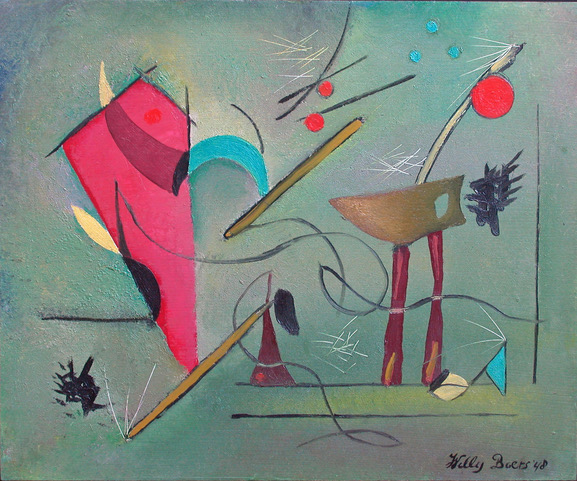
Willy Boers (1905–1978) was a pioneering Dutch painter who transitioned from realism to pure abstraction after World War II. A founder of the groups Vrij Beelden (Free Images) and Creatie, he sought to express spiritual and emotional freedom through form and color, becoming one of the foremost advocates of abstract art in the Netherlands.
“Art had to be free again—free from imitation, free to express the inner life. Abstraction was not a style for Boers; it was a necessity.”
Willy Boers, born in Amsterdam in 1905, began his artistic journey with realistic landscapes and portraits. Yet his search for a deeper truth led him to abandon representation in favor of abstraction. After World War II, when moral and artistic certainties had collapsed, Boers declared that artists could no longer paint as they had before. Out of this conviction emerged a new vision: art as a symbol of freedom and renewal. In 1946, Boers founded Vrij Beelden (Free Images), a group of artists united by a shared commitment to non-figurative painting. Their aim was to create art liberated from nature and narrative—to restore the autonomous power of line, color, and rhythm. Later, dissatisfied with lingering traces of figuration, he established Creatie (1950), the first Dutch association devoted entirely to “absolute art.” Boers’s work evolved from structured Cubist and Futurist forms to expressive, tactile surfaces influenced by Action Painting and Tachisme. His paintings and gouaches from this period vibrate with energy—dense textures, floating symbols, and dynamic rhythms reflecting both turmoil and transcendence. Critics praised his style as “integral expressionism,” a synthesis of discipline and emotion. Beyond painting, Boers was a prolific writer and organizer, contributing essays to major art journals and advocating for modernism in postwar Europe. His leadership in Vrij Beelden and Creatie helped shape the Dutch avant-garde, linking it to the broader European abstract movement. In the 1950s, his work moved toward heavy material compositions—dense, crusted surfaces that seemed to grow organically, earning the nickname “The Boards.” By the 1960s, he turned to collages incorporating paper, fabric, and text fragments, exploring the visual poetry of signs and traces. Throughout his life, Boers remained a reflective, uncompromising artist. He saw abstraction not as an escape from reality but as a means of confronting it—transforming chaos into harmony, destruction into creation. His legacy endures as that of a visionary who gave Dutch art a new language of freedom and form.
Back to Exhibitions